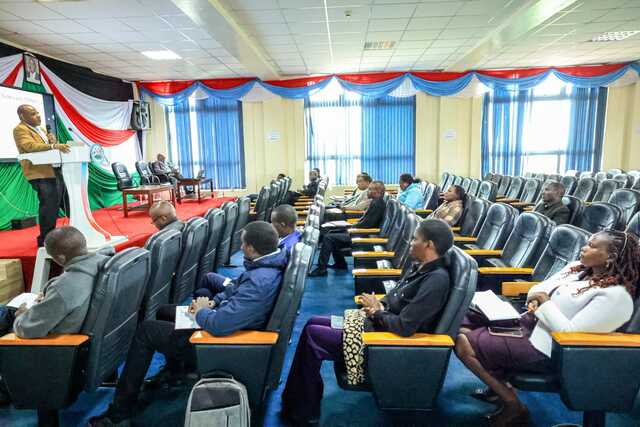
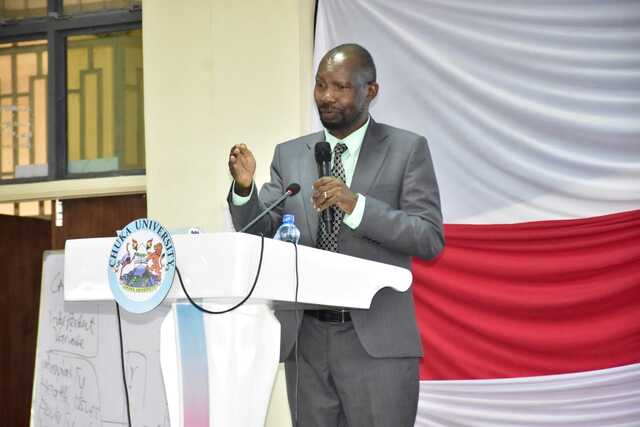
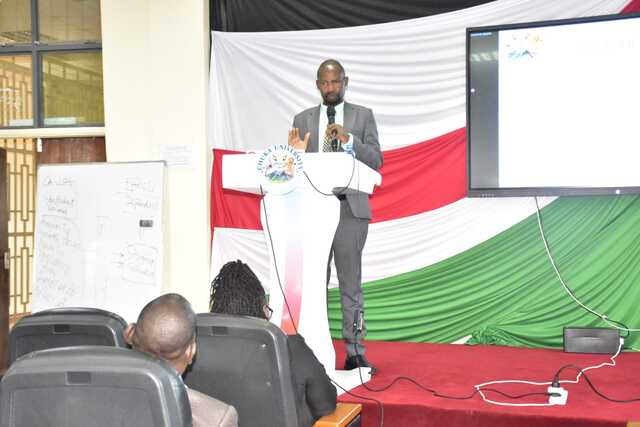
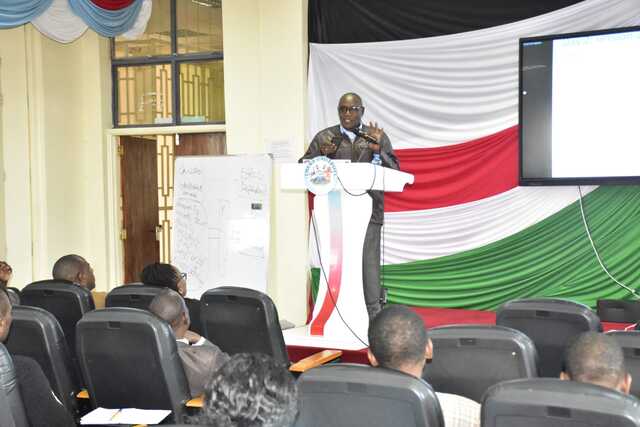
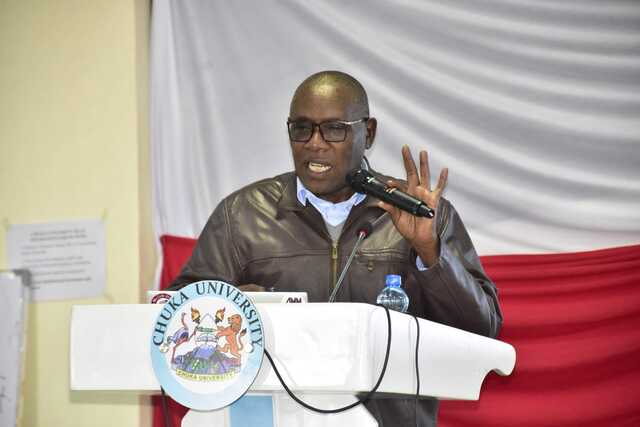
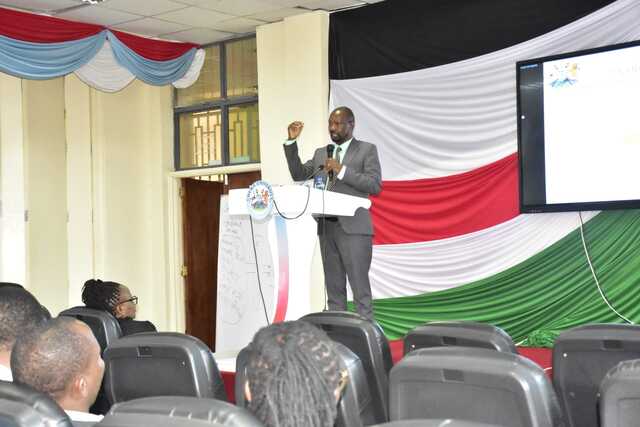
The second day of the workshop shifted focus from postgraduate students to supervisors, bringing together experienced researchers and academic leaders to deliberate on best practices in postgraduate supervision under the theme, “Enhancing Quality Postgraduate Research, Supervision and Timely Completion.”
Addressing the supervisors’ workshop, the Dean Faculty of Humanities and Social Sciences, Prof. Kyalo Wa Ngula, reminded participants that the quality of any university is ultimately reflected in the calibre of its graduates and that postgraduate supervision remains central to achieving academic excellence.
“The quality of a university is ultimately reflected in the quality of its graduates. If that is true, then the quality of postgraduate supervision lies at the very heart of our reputation as a Faculty and a University,” Prof. Wa Ngula said.
He observed that every completed thesis or dissertation represents more than a student’s effort; it reflects a successful partnership between the student and the supervisor founded on mentorship, scholarly guidance and professional commitment.
The Dean acknowledged that postgraduate supervision has become increasingly complex, noting that the challenges facing supervisors today should not be viewed as institutional failures but as opportunities for continuous improvement.
“We gather today not because FHSS postgraduate supervision is broken, but because it is increasingly complex. Supervision presents challenges that require continuous reflection and refinement,” he remarked.
Prof. Wa Ngula further emphasized that effective postgraduate supervision is a shared scholarly responsibility built on clearly defined roles, mutual respect, professionalism, accountability and institutional support. He urged participants to openly exchange experiences and adopt emerging best practices that would strengthen supervision and improve the quality, credibility and impact of postgraduate scholarship at Chuka University.
The day’s discussions began with Prof. Moses Muraya, who led a session on Principles, Best Practices and Chuka University Policy Guidelines in Postgraduate Supervision. He underscored the importance of supervisors understanding and consistently applying institutional policies while maintaining high standards of mentorship and academic accountability throughout the supervision process.
Renowned research methodology scholar Prof. Donald Kisilu Kombo facilitated several key sessions, beginning with Supervisor–Student Relationships, Mentorship and Managing the Supervision Process. Building on his Day One presentations to postgraduate students, he emphasized that successful supervision is anchored on mutual trust, effective communication and clearly defined expectations.
“Effective supervision is not about controlling students; it is about mentoring them to become independent researchers capable of generating new knowledge,” Prof. Kombo observed.
He further challenged supervisors to cultivate supportive academic environments that encourage critical thinking, scholarly independence and timely progress.
The workshop also featured a session on Ethical Issues in Research Supervision facilitated by Deputy Vice-Chancellor (Academic, Research and Student Affairs), Prof. Gilbert Nduru, who emphasized that supervisors are custodians of academic integrity and play a pivotal role in ensuring ethical research practices.
Prof. Nduru urged supervisors to guide students in observing research ethics, maintaining originality in scholarly work and complying with institutional and national ethical standards.
Later, Prof. Kombo returned to facilitate sessions on Ensuring Quality in Postgraduate Research: Methodological Guidance, Research Ethics and Quality Assurance Requirements, Providing Constructive Feedback, Monitoring Progress and Supporting Timely Completion, and Contemporary Challenges in Postgraduate Supervision and Emerging Best Practices.
Drawing from decades of experience in postgraduate supervision, he reminded supervisors that quality assurance begins long before thesis examination.
“Quality is not something you inspect at the end of research. It is built into every stage of supervision—from refining the research problem and methodology to providing timely, constructive feedback,” he emphasized.
Prof. Kombo also encouraged supervisors to embrace mentorship as a continuous process that nurtures scholarly confidence while maintaining academic standards.
Throughout the workshop, facilitators reiterated that effective supervision extends beyond reviewing drafts. It requires continuous engagement, professional mentorship, methodological guidance, ethical leadership and regular monitoring of student progress to ensure timely completion of research projects.
The capacity-building seminar concluded the University’s two-day postgraduate mentorship programme, which had begun with intensive sessions for postgraduate students on proposal and thesis writing, research methodology, conceptual and theoretical frameworks, academic writing and research ethics.
Together, the two days provided a comprehensive platform for strengthening both postgraduate researchers and their supervisors. While the first day equipped students with practical skills for developing rigorous and impactful research, the second day empowered supervisors with enhanced knowledge and strategies for guiding postgraduate scholars effectively.