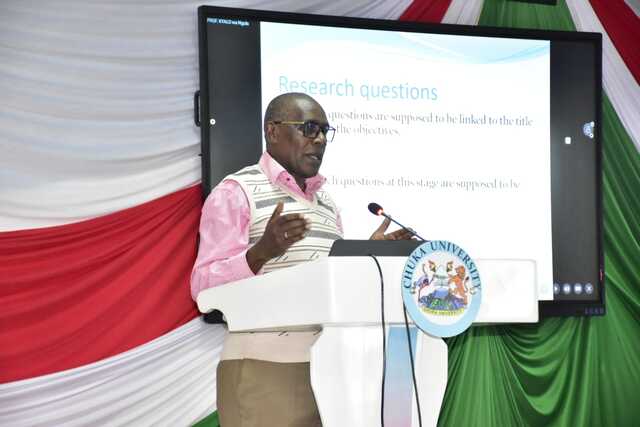
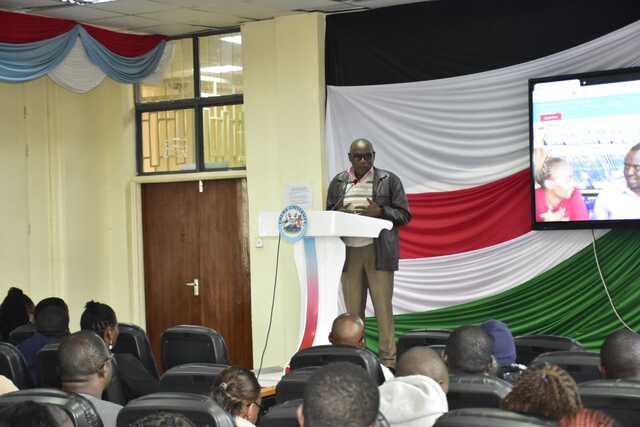
Professor Kombo, a Full Professor of Sociology of Education at Kenyatta University and one of Kenya’s foremost authorities in educational research and research methodology, guided scholars through some of the most fundamental stages of postgraduate research under the programme’s theme, “Enhancing Quality Postgraduate Research, Supervision and Timely Completion.”
Drawing from more than three decades of experience in research, supervision and academic mentorship, Prof. Kombo delivered practical sessions on identifying and defining research problems, formulating research objectives, questions and hypotheses, developing conceptual frameworks, achieving alignment in research, research design, methodological rigour, sampling and data collection, academic writing, referencing, scholarly presentation, and common mistakes in proposal and thesis development.
Speaking during the workshop, Prof. Kombo emphasized that quality research begins with identifying a genuine knowledge gap rather than merely selecting an interesting topic.
“A research problem is not simply an issue you observe. It is a gap in knowledge that requires investigation. Your study must demonstrate what is not known, why it matters, and how your research will contribute to filling that gap,” he told the postgraduate scholars.
He further explained that a strong research title should be concise, focused and capable of communicating the variables under investigation. According to him, every component of a research proposal should work together seamlessly.
“Your title, problem statement, objectives, research questions, hypotheses and methodology must speak the same language. Once these elements are aligned, your proposal becomes logical, coherent and easier to defend,” Prof. Kombo noted.
The seasoned researcher reminded students that research objectives serve as the roadmap of every study and should be specific, measurable, achievable and directly linked to the problem being investigated. Likewise, research questions and hypotheses should emerge naturally from the objectives, maintaining consistency throughout the research process.
On conceptual and theoretical frameworks, Prof. Kombo explained that conceptual frameworks illustrate the relationships among variables, while theoretical frameworks provide the scholarly lens through which the study is understood and interpreted.
Addressing research methodology, he encouraged scholars to carefully select research designs that best answer their research questions rather than choosing methods based on convenience or familiarity. He outlined various research designs including descriptive, experimental, quasi-experimental, correlational, cross-sectional and case study designs and stressed the importance of selecting appropriate sampling procedures and reliable data collection instruments.
He also reminded students that methodological rigour is essential in producing credible research findings.
“Research is not about collecting data for the sake of it. Every method you choose must answer your research questions and support your objectives. Rigour in methodology is what gives credibility to your findings,” he emphasized.
Professor Kombo further advised students to uphold academic integrity through proper referencing, ethical research practices and scholarly writing. He cautioned against common weaknesses that delay postgraduate completion, including poorly formulated research problems, vague objectives, inconsistent methodologies, weak conceptual frameworks and failure to maintain alignment across different sections of a proposal or thesis.
Introducing the keynote facilitator, the Faculty described Professor Kombo as one of Kenya’s most distinguished scholars in educational research and research methodology. His academic contributions span international conferences, peer-reviewed publications, curriculum development, educational policy and postgraduate supervision. His widely acclaimed book, Proposal and Thesis Writing: An Introduction, has guided generations of postgraduate students and researchers across Africa and beyond.
As the mentorship programme progresses, Professor Kombo’s sessions have equipped postgraduate scholars with practical knowledge and valuable insights that will enable them to develop rigorous, relevant and impactful research capable of informing policy, advancing scholarship and contributing to sustainable development.